BORDERLINE

Borderline personality disorder as a disorder of the need for a secure presence

For many people with borderline personality disorder, the difficulties are not limited to emotional regulation. They also concern how the presence of others is experienced and interpreted.
Early relational experiences have sometimes taught the nervous system a difficult lesson: others are essential for feeling safe, but they can also become a source of pain, unpredictability, or abandonment.
The presence of others then becomes deeply ambiguous. It is sought after because it brings comfort, but it can also trigger fear, vigilance, or suffering.
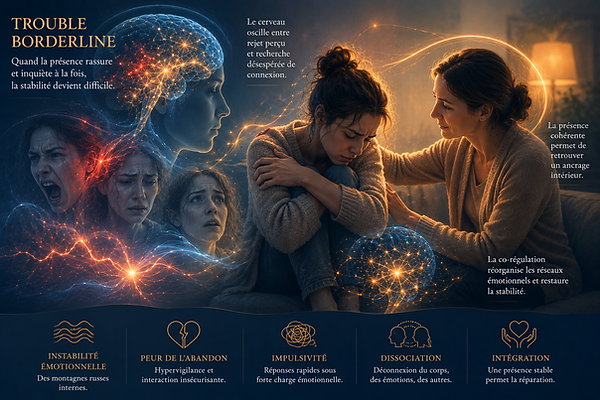
From this perspective, borderline functioning can be understood as a difficulty in experiencing a truly secure presence. The nervous system continues to oscillate between the need for closeness and the fear of what this closeness might entail. The problem is that the presence of the other has simultaneously become a source of security and a source of alarm.
The problem is not the relationship itself.

What borderline functioning does to the
brain and nervous system

Neuroscience now shows that people with borderline personality disorder often experience emotions with particular intensity. This isn't simply a matter of sensitivity or personality. It's also the result of a nervous system that reacts strongly to signals of proximity, distance, rejection, or abandonment.
The brain systems involved in attachment, emotional memory, danger detection, and emotion regulation can remain highly activated even when no objective threat is present. Distance in the relationship can be experienced as abandonment. Criticism as rejection. Uncertainty as danger.
These reactions are generally not chosen. They correspond to automatic responses of the brain and nervous system, developed over time to try to preserve the bond, maintain closeness or regain a feeling of security.
When this state of relational vigilance becomes chronic, it can lead to great suffering: anxiety, impulsivity, repeated conflicts, feelings of emptiness, self-destructive behaviors, or difficulties in maintaining a stable self-image.

Borderline personality disorder as a relational security disorder

Others are essential for feeling safe, but they can also be a source of pain, unpredictability, or threat.
This contradiction often creates a permanent tension between two equally powerful needs: the need for closeness and the fear of being hurt, rejected, or abandoned.
From the perspective of the Presence Brain, borderline functioning can be understood as the story of a nervous system that has had to learn to live with this contradiction. The problem is not the relationship itself.
The problem is not the relationship.
The problem is that the relationship has simultaneously become a source of security and a source of warning.
It is precisely this tension that makes some relationships so important, so intense, and sometimes so painful.

How I work

Therapeutic work is not intended to change your personality. It aims to help the brain and nervous system regain greater stability, security, and emotional flexibility.

Depending on your history and needs, support can help you better understand certain emotional reactions, develop more effective regulation skills, reduce fear of rejection or abandonment, reprocess certain traumatic experiences, and build more stable and peaceful relationships.

My approach integrates EMDR, complex trauma-focused therapies, schema therapy, polyvagal theory, and current knowledge in affective and relational neuroscience.

The therapeutic relationship itself often constitutes an important part of the work. It gradually offers the nervous system the experience of a presence that is sufficiently stable, predictable, and secure to allow the emergence of new ways of relating to oneself and to others.

Change is not about becoming someone else. It often involves discovering that it is possible to experience relationships with more security, freedom, and trust.

The pace is always yours. The work is built gradually, respecting your history, your resources, and what you are ready to go through at each stage of the process.

Sessions can take place in person in Marseille or via secure teleconsultation, for people in France as well as internationally.
To go further
Borderline personality disorder lies at the intersection of trauma, attachment, emotional regulation, and human relationships.
These questions are regularly addressed in blog articles as well as in the Presence Brain project, which explores the role of presence in development, mental health and psychotherapy.

CONTACT FORM & APPOINTMENT BOOKING

EMDR EMDR – Understanding how reprocessing difficult memories can promote psychological healing.
Trauma Better understanding the consequences of simple or complex psychological trauma.

BORDERLINEt Understanding the brain gradually learns whether it can rely on the presence of others.

ANXIETY Borderline Personality Disorder – Understanding the difficulties of emotional and relational regulation.
Scroll to Top