ABOUT
Neuroscience, Psychotherapy & The Brain of Presence
A simple question, at the heart of everything
Is the brain really designed to function on its own?
Social neuroscience generally defines sociality in terms of human interactions—communication, cooperation, empathy, theory of mind. But could sociality begin before any interaction? Even before words? At the moment when the brain must first answer a more fundamental question:
"Is anyone here?"
This question lies at the heart of my current research and the project The Brain of Presence.
Who I am
After more than forty years devoted to the study of the brain, attention, neural networks and behavior, I have gradually been led to a question that I had not anticipated: what happens to the brain in the presence of others?
I am Driss Boussaoud — neuroscientist, Emeritus Research Director at the CNRS, clinical psychologist, neuropsychologist and EMDR therapist in Marseille.
Not only during explicit interactions — conversation, cooperation, exchange. But before. From the moment another organism is simply there, perceived, felt, available. Or absent.
This question transformed my approach to research. And gradually, it also transformed my approach to clinical practice.

A journey between laboratory and office
My training is twofold. A neuroscientist by training — a doctor of neuroscience, qualified to supervise research, founder and director of the Mediterranean Institute of Cognitive Neuroscience (INCM) — I have also completed comprehensive clinical training in psychology, with a specialization in neuropsychology and certification in EMDR therapy.
This dual focus is not a coincidence. It stems from a conviction I have gradually developed: neuroscience and clinical practice need each other. Discoveries about the brain should not remain confined to laboratories. And clinical practice benefits from a precise understanding of what happens neurobiologically in suffering, in relationships, and in healing.
I currently practice as a clinical psychologist in Marseille, with a focus on neuropsychology and psychotherapy—trauma, anxiety, relationship difficulties, attachment issues, and emotional regulation. My approach integrates EMDR, schema-based therapies, ACT therapy, polyvagal theory, and insights from contemporary neuroscience.
The Brain of Presence — an ongoing project
The Presence Brain project explores the hypothesis that the presence of others—or their absence—is not simply a contextual factor in mental functioning. It is one of the conditions that help to organize it, from synaptic mechanisms to large cognitive networks.
This project takes several forms simultaneously.
On the scientific front, a journal article—"The Brain of Presence: A Foundational Framework for Social Neuroscience"—is currently freely available on the OSF (Open Science Framework) platform. It draws in particular on a study published in 2025 in Communications Biology, showing that the presence of a conspecific modifies synaptic efficiency across several scales of brain organization, in both monkeys and humans. A book, intended for a wider audience, is also in progress.
Clinically, this framework sheds a different light on the realities I encounter every day in practice: anxiety as hypervigilance to presence, trauma as a rupture of presence, depression as the experience of a brain that carries alone what it expected to carry with several, therapy as the progressive restoration of a soothing presence.
In terms of transmission, this platform — with its articles, blog and newsletter — is the place where these ideas are explored, expanded and shared, at the crossroads of research, clinical practice and ordinary human experience.
What I believe
Neuroscience can help us better understand why certain presences soothe us, why isolation can be so costly, why trauma transforms the way we perceive others, and why human presence and relationship profoundly alter the brain.
But this understanding only makes sense if it connects with lived experience — that of patients, practitioners, and anyone who wonders why they feel different depending on whether they are alone or accompanied.
This is the dialogue that this site seeks to maintain.
EMDR EMDR – Understanding how reprocessing difficult memories can promote psychological healing.
Trauma Better understanding the consequences of simple or complex psychological trauma.
Anxiety Understanding the mechanisms of worry, hypervigilance and panic attacks.
Depression Exploring the link between mental exhaustion, loss of momentum and feelings of disconnection.
Attachement Understanding the brain gradually learns whether it can rely on the presence of others.
COUPLES THERAPYCouple therapy – Understanding relational dynamics and attachment difficulties in the couple.
Consultations Practical information about consultations in Marseille or via teleconsultation.
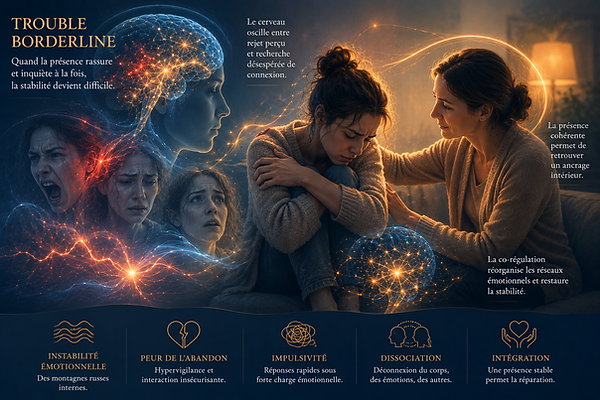
Blog Article Borderline Personality Disorder: Better Understanding for Better Treatment →
Diplomas and professional credentials
Clinical psychologist and neuropsychologist. Master's degree in Psychology — Aix-Marseille University. PhD in Neuroscience — Claude Bernard University Lyon 1. Habilitation to Supervise Research (HDR) — Claude Bernard University Lyon 1.
Emeritus Research Director at the CNRS. Founder and former Director of the Mediterranean Institute of Cognitive Neuroscience (INCM). Former Deputy Director of the Institute of Systems Neuroscience (INS). Founding member and former President of the Mediterranean Society for Neuroscience (MNS).
RPPS No. : 10010048246 — SIREN No. : 102766474