Welcome to the Brain
of Presence.

Presence Neuropsychotherapy
A platform dedicated to psychotherapy, neuropsychology and the neuroscience of presence.

Understanding science

Acting in the clinical setting

Transmitting knowledge

Promote transformation
A research-based approach, informed by clinical practice, in service of humanity.

THE BRAIN OF PRESENCE

An integrated platform dedicated to science, transforming lives, and sharing knowledge.

THE BRAIN OF PRESENCE

Where does sociality begin?
What if the human brain never functioned entirely on its own?
For several years, various studies have shown that the mere presence of others can modify cognitive performance, neuronal recruitment, or even certain forms of synaptic plasticity.
At the same time, social neuroscience and the concept of the social brain have profoundly renewed our understanding of human mental life, seeking to understand how processes such as empathy, theory of mind, mentalization, or more broadly social cognition emerge and are supported by the brain.

Or perhaps you are here to explore a more fundamental question

Trauma & EMDR

The support aims to help the brain reprocess these experiences: EMDR and trauma-focused therapies and emotional regulation, ACT therapy, schema therapy, and contributions from contemporary neuroscience.

Neuropsychology

Neuropsychological assessment helps to better understand attentional, executive or learning difficulties in children, adolescents and adults.

The Brain of Presence:

You are interested in the brain, psychology, or neuroscience.
You wonder how the presence of others influences our emotions, our attention, our learning, or our mental health.
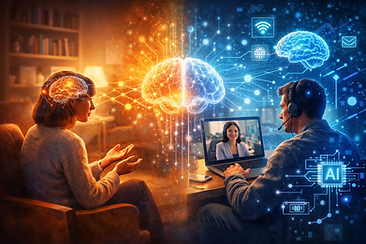
You are looking for content that connects scientific research and human experience.
My recent research focuses in particular on a simple question:
At what point does the presence of others begin to shape the brain?
It is this reflection that gave birth to the project of this platform The Brain of Presence, which I am delighted to share with you.

Trauma & EMDR

The support aims to help the brain reprocess these experiences: EMDR and trauma-focused therapies and emotional regulation, ACT therapy, schema therapy, and contributions from contemporary neuroscience.

Neuropsychology

Neuropsychological assessment helps to better understand attentional, executive or learning difficulties in children, adolescents and adults.

The Brain of Presence:

You are interested in the brain, psychology, or neuroscience.

You wonder how the presence of others influences our emotions, our attention, our learning, or our mental health.

You are looking for content that connects scientific research and human experience.
My recent research focuses in particular on a simple question:
At what point does the presence of others begin to shape the brain?
It is this reflection that gave birth to the project of this platform The Brain of Presence, which I am delighted to share with you.

The question posed here is different.

It consists of asking whether, in this theoretical framework, sociality is not addressed a little late, once more fundamental processes are already at work.
Because before any communication, before any interaction, sometimes even before any explicit awareness of the other, the brain must already have an answer, however approximate, to a fundamental question:
In an empty room, the answer is easy, almost instantaneous. But this is an exception. Most of the time, the presence of others isn't observed directly; it's inferred. A noise in the next room, the feeling of being watched without being certain, a silhouette glimpsed out of the corner of your eye—in these ordinary situations, the brain doesn't have a binary response. It maintains a continuous, constantly updated estimate, accompanied by a varying level of confidence: someone might be there, probably is, definitely is—or not.
The Presence Brain proposes to explore this hypothesis: this assessment of the presence of others is not a mere prelude to social life, triggered and then forgotten. It runs continuously, like a background against which attention, cognition, and behavior are organized—just as much, for example, as attention itself. It is precisely because it is continuous that it deserves the status of a foundational condition, and not simply a contextual factor.
This same zone of uncertainty—where presence must be inferred rather than observed—is also where the model intersects with clinical practice. Underestimating a real signal of presence, overestimating it, or applying a chronically biased weighting: these are avenues for understanding certain experiences of derealization, hypervigilance, or social anxiety. These avenues are not a separate development from the theoretical hypothesis; they are a direct extension of it.

Scientific references

Boussaoud

D. (2026, June 25). The Brain of Presence: A Foundational Framework for Social Neuroscience. Retrieved from osf.io/preprints/psyarxiv/tpnze_v2

Demolliens

et al. (2017). Social and asocial prefrontal cortex neurons: a new look at social facilitation and the social brain. Social Cognitive and Affective Neuroscience, 2017, 1241–1248

Bennani

A., El Ahmadi, A., Channouf, A., et al. (2023). Social facilitation and bilingual cognitive advantage: Bridging social psychology and psycholinguistics. Heliyon, 9, e13239.

Charaf

K., Agoub, M. and Boussaoud, D. (2024). Associative learning and facial-expression recognition in schizophrenic patients: Effects of social presence. Schizophr. Res. Cogn., 35, 100295.

Esmaeili

A., Demolliens, M., Viersen, M., et al. (2025). Probabilistic inference of social presence across brain scales reveals enhanced synaptic efficacy. Common. Biol., 8, 1608

About the founder

Psychologist & Neuropsychologist, EMDR Therapist in Marseille

I am a neuroscientist, Emeritus Research Director at the CNRS, clinical psychologist, neuropsychologist and EMDR therapist, based in Marseille.
My background combines over forty years of brain research with a clinical practice focused on psychotherapy, neuropsychology, and trauma. This dual experience forms the basis of a neuroscience-informed approach, in which research-based knowledge illuminates the understanding of psychological suffering—and the conditions for change.
I see adults, teenagers and children in three main areas:
Neuropsychology & ADHD — attentional disorders, executive functions, learning difficulties, ADHD in children, adolescents and adults.
Psychotherapy — depression, psychological exhaustion, personal or relational difficulties, development of new psychological resources.
Consultations take place in Marseille or via teleconsultation, in French and English.

THE SOCIAL BRAIN

A revolution… perhaps incomplete
The concept of the social brain has profoundly transformed neuroscience. It has shown that our emotions, decisions, and behaviors depend on others — that the brain is not an isolated organ.
This revolution is real. But it may have identified sociality somewhat late in the human experience.
Because in most classical models, sociality emerges when the brain engages in elaborate forms of interaction: understanding others, interpreting intentions, communicating, cooperating, sharing complex emotions. Empathy, theory of mind, attachment, social cognition: all these processes are now well documented.
But this way of framing the problem could leave something in the shadows.

CONTACT FORM & APPOINTMENT BOOKING

EMDR EMDR – Understanding how reprocessing difficult memories can promote psychological healing.
Trauma Better understanding the consequences of simple or complex psychological trauma.

BORDERLINEt Understanding the brain gradually learns whether it can rely on the presence of others.

ANXIETY Borderline Personality Disorder – Understanding the difficulties of emotional and relational regulation.
Scroll to Top