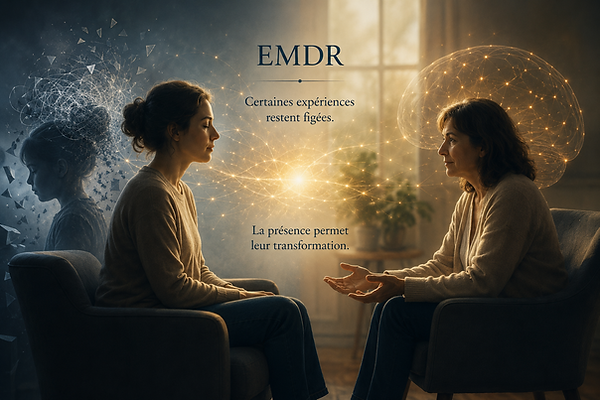
EMDR
What is EMDR?
EMDR—Eye Movement Desensitization and Reprocessing—is an internationally recognized psychotherapeutic approach for treating trauma, anxiety, and many persistent emotional distresses. It is recommended by the WHO and the French National Authority for Health (HAS) for the treatment of post-traumatic stress disorder.
This can manifest as anxiety, hypervigilance, nightmares, flashbacks, intense emotional reactions, relationship difficulties, or a persistent feeling of inner insecurity.
Après un événement difficile — accident, violence, deuil, humiliation, séparation, harcèlement, négligences affectives ou stress chronique — il arrive que le cerveau ne parvienne pas à intégrer pleinement ce qui a été vécu. Le souvenir reste alors chargé émotionnellement, comme si une partie du cerveau continuait à réagir au passé dans le présent.
Cela peut se manifester par de l’anxiété, une hypervigilance, des cauchemars, des flashbacks, des réactions émotionnelles intenses, des difficultés relationnelles, ou un sentiment persistant d’insécurité intérieure.
How it works — what neuroscience explains
EMDR uses alternating bilateral stimulation—eye movements, sounds, or tapping—while the patient focuses on a difficult memory. This stimulation appears to facilitate the reprocessing of traumatic memories by activating mechanisms similar to those of REM sleep, the phase during which the brain naturally consolidates and integrates the day's experiences.
Gradually, memories lose their excessive emotional charge. They remain accessible, but no longer trigger the same intensity of reaction. The brain and body are no longer prisoners of certain experiences.
What EMDR can treat
EMDR is now used far beyond post-traumatic stress. It can help in many situations: simple or complex trauma, chronic anxiety, panic attacks, depression, phobias, burnout, grief, relationship difficulties, old emotional wounds, and fragile self-esteem.
The goal is not to erase memories, but to allow the brain and body to no longer be held captive by certain experiences. Gradually, the person regains greater inner freedom, emotional stability, and adaptability.
Presence at the heart of the process
The effectiveness of EMDR is not based solely on the technique.
The quality of the therapeutic relationship, the feeling of security, and the ability of the nervous system to feel sufficiently supported play an equally essential role in the reprocessing process.
The human brain does not process difficult experiences in isolation. It stabilizes, reorganizes, and rebuilds itself within a safe relational environment. In this sense, EMDR can be understood as a therapy for emotional regulation and relational presence as much as a technique for processing memories.
C’est cette dimension — le rôle de la présence dans la guérison — qui est au cœur de ma pratique clinique, et que j’explore également dans mes recherches en neurosciences.

My approachAfter more than forty years devoted to neuroscience research at the CNRS, I chose to direct this stage of my career towards neuropsychotherapy: understanding how life experiences, emotions, relationships and brain function contribute to psychological suffering as well as the healing process.
My EMDR practice is based on an integrative approach that combines contemporary neuroscience, polyvagal theory, work on complex trauma, and an understanding of the social brain. Each session is tailored to your pace, your history, and your needs.
Therapeutic work is not simply about suppressing symptoms. It aims to gradually restore a more stable sense of inner security, emotional coherence, and self-presence.

In-person consultation in Marseille or via teleconsultation
Sessions can take place in person in Marseille or via secure teleconsultation. Recent research and clinical experience show that EMDR can be practiced effectively remotely when the therapeutic framework is adapted — allowing many people, both in France and internationally, to access specialized support.
CONTACT FORM & APPOINTMENT BOOKING
EMDR EMDR – Understanding how reprocessing difficult memories can promote psychological healing.
Trauma Better understanding the consequences of simple or complex psychological trauma.
BORDERLINEt Understanding the brain gradually learns whether it can rely on the presence of others.
ANXIETY Borderline Personality Disorder – Understanding the difficulties of emotional and relational regulation.