COUPLES THERAPY

When the relationship becomes a source of suffering and misunderstanding

Do you feel like you always fall back into the same arguments, the same tensions, or the same misunderstandings?
Sometimes, partners know they love each other—but can no longer talk calmly, understand each other, or feel truly close. Some situations quickly become explosive. Other couples drift apart gradually in silence, emotional exhaustion, or the feeling of no longer truly connecting.
Over time, this can lead to frustration, repeated hurt, hypersensitivity to the other person's words — and a form of loneliness at the very heart of the relationship.

What neuroscience reveals about couple relationships

Emotional relationships deeply engage the brain systems involved in attachment, security, and emotional regulation. During periods of tension, the nervous system can quickly switch to automatic defense mechanisms—anger, withdrawal, avoidance—that often have nothing to do with what each person truly wants for the relationship.

These reactions do not reflect a lack of love or goodwill. They correspond to deep emotional mechanisms that are activated when the presence of the other becomes a source of insecurity rather than security.

This is precisely where the central issue of many couple crises lies: not a disagreement on values ​​or plans, but a transformation of the way in which each person perceives and feels the presence of the other.

Presence at the heart of the relationship

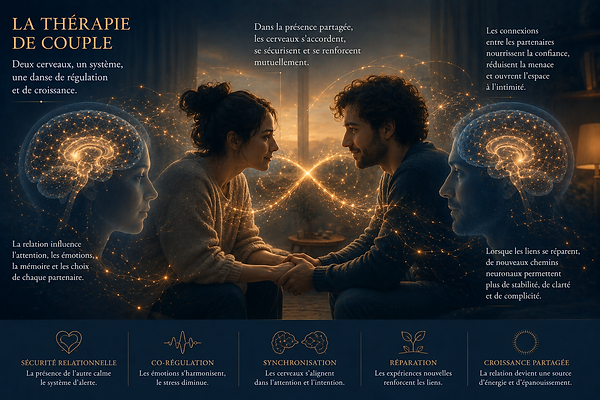
Neuroscience research shows that the presence of another person perceived as safe profoundly alters our brain function—reducing vigilance, lowering defenses, and allowing for smoother emotional regulation. This is what Social Baseline Theory calls the neurobiological benefit of co-presence: the brain functions less efficiently and more flexibly when it can rely on the presence of a trusted individual.
In a troubled relationship, this mechanism often reverses: the other person's presence—once calming—has become alarming. The body tenses, defenses are activated, and words become erratic. Not out of ill will, but because the nervous system has learned to perceive this presence as unpredictable or threatening.
Couple therapy works to restore this fundamental dimension: that the presence of the other can gradually become a resource rather than a source of alarm.

How I work

Couple therapy offers a safe space to slow down these dynamics, better understand what is happening in the relationship and gradually regain more dialogue, emotional security and mutual understanding.

My approach integrates attachment theories, emotional regulation, contemporary relational neuroscience, and relational psychotherapy. It is based on the conviction that both partners are caught up in dynamics that transcend them individually—and that understanding these dynamics together is already a form of transformation.

The task is not to determine who is right or wrong. It is to enable each person to better understand how the presence of the other affects their nervous system — and to create the conditions for that presence to become possible and calming again.

In-person or via teleconsultation: Sessions can take place in person in Marseille or via secure teleconsultation.

CONTACT FORM & APPOINTMENT BOOKING

EMDR EMDR – Understanding how reprocessing difficult memories can promote psychological healing.
Trauma Better understanding the consequences of simple or complex psychological trauma.

BORDERLINEt Understanding the brain gradually learns whether it can rely on the presence of others.

ANXIETY Borderline Personality Disorder – Understanding the difficulties of emotional and relational regulation.
Scroll to Top