The biological roots of sociality…
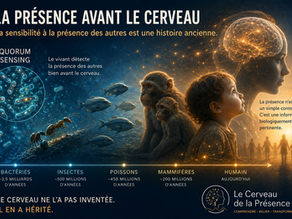
Has the presence of others influenced living things for longer than the brain itself? From bacteria capable of detecting the density of their neighbors to human brain networks sensitive to social presence, a central hypothesis of the Presence Brain project is emerging: sociality does not begin with interaction, but with the ability to detect that others are there.

Most theories of the social brain begin with interaction. Some begin with the brain itself. They seek to understand how organisms perceive their conspecifics, communicate with them, cooperate, or build relationships.
The Brain of Presence project leads to a more radical question: what if sensitivity to the presence of others was older than the brain itself? The Brain of Presence: conduit à poser une question plus radicale : et si la sensibilité à la présence des autres était plus ancienne que le cerveau lui-même ?
We spontaneously tend to consider presence as a psychological phenomenon, or even as a conscious experience. Yet, if we go back far enough in the history of life, another possibility emerges. Before being a lived experience, before being a cerebral mechanism, presence could be a fundamental biological fact.
Is anyone there?
To explore this idea, let's imagine a marine bacterium.
It possesses neither a brain, nor a nervous system, nor consciousness in the way we usually understand it. Yet, it is capable of modifying its behavior depending on the number of other bacteria present in its environment. When the density of neighboring organisms reaches a certain threshold, it changes the expression of its genes, adapts its survival strategies, and behaves differently depending on whether it is alone or surrounded.
This mechanism is known as quorum sensing . quorum sensing.
Each bacterium constantly releases small chemical molecules into its environment. As the number of bacteria increases, the concentration of these molecules also increases—a continuous, chemical estimate of the density of its kind, rather than a simple count. When a critical threshold is reached, the entire population changes its behavior in a coordinated manner—but this collective coordination relies on information that has never stopped gradually changing. (Miller & Bassler, 2001) (Miller & Bassler, 2001)
The bacterium does not directly perceive its neighbors. It perceives their trace. But this trace is enough to inform an estimation, more or less strong depending on the perceived concentration: is someone there? And this estimation modifies what the bacterium does. quelqu’un est-il là ? Et cette estimation modifie ce que la bactérie fait.
This is not a metaphor
Il serait tentant de considérer le quorum sensing It would be tempting to consider quorum sensing as a simple analogy for presence. However, that would be to miss the point entirely.
Le quorum sensing Quorum sensing is not a metaphor for presence. It is a presence detection mechanism. It allows an organism to adjust its behavior based on the presence of other organisms.
This mechanism has been preserved by evolution because it confers a decisive advantage. In certain situations, survival depends precisely on the ability to take into account the presence of others.
In very different forms, this principle reappears throughout the history of life. A single idea seems to run through evolution: the presence of others constitutes biologically relevant information. And this information modifies behavior.
The brain did not invent presence
This perspective leads us to look at the brain from a slightly different angle.
We often tend to think of the brain as the origin of sociality. However, it may be more accurate to say that it inherited much older mechanisms.
The brain did not invent sensitivity to presence. It transformed it. It amplified it. It integrated it into ever more complex forms of information processing.
In social insects, the presence of conspecifics organizes sophisticated collective behaviors. In fish, it regulates school cohesion and responses to predators. In rodents, it influences learning, risk-taking, and stress regulation—effects documented in studies on social facilitation and the presence of an observer. In primates, it shapes social behaviors, observation of others, and the acquisition of new skills.
These effects are not anecdotal. They reveal a remarkable functional continuity: at each level of complexity of living organisms, the presence of others constitutes information that modifies the organism's behavior. It is this continuity that the Brain of Presence project seeks to formalize, down to the finest levels of human brain organization. The Brain of Presence: cherche à formaliser, jusqu’aux niveaux les plus fins de l’organisation cérébrale humaine.
In humans, social presence penetrates to the finest levels of brain organization—from synaptic mechanisms to the large networks involved in attention, emotions, and social cognition. "Social" and "asocial" prefrontal neurons have thus been identified in non-human primates (Demolliens et al., 2017), and effects have been observed at different levels of neuronal organization (Esmaeili et al., 2025; Tricoche et al., 2025). Des neurones préfrontaux « sociaux » et « asociaux » ont ainsi été identifiés chez le primate non-humain (Demolliens et al., 2017), et des effets ont été observés à différents niveau de l’organisation neuronale (Esmaeili et al., 2025; Tricoche et al., 2025).
Between the bacterium that chemically detects the density of its neighbors and the human being who instantly perceives that they are not alone in a room, billions of years of evolution have passed. But a continuity remains. At each stage, organisms have had to answer the same question: Is anyone there? Y a-t-il quelqu’un ?
An evolving continuity
We often tend to view sociality as a complex property that appeared relatively late in the history of life, thanks to intelligence, language, or consciousness. This intuition is understandable. The most elaborate forms of communication and cooperation do indeed seem to depend on sophisticated cognitive abilities.
But this perspective could lead us to overlook something more fundamental.
What if what we now call social cognition, attachment, cooperation, or communication was based on a much older principle?
What if all these abilities stemmed from a more basic property: the capacity to detect the presence of other organisms and adjust one's behavior accordingly? From this perspective, sociality would not begin with interaction. It would begin with presence.
What this changes
This hypothesis profoundly transforms the initial question.
If sensitivity to presence is a biological mechanism conserved for billions of years — before the nervous system, before the brain, before consciousness — then it is not a late consequence of social cognition. It may well be its very foundation.
Communication, cooperation, empathy, or theory of mind then appear as progressive elaborations of a more fundamental property: the ability to detect that other organisms are present and to adjust one's behavior accordingly.
Before speech. Before thought. Before even the brain. There was already presence. Perhaps understanding presence, then, is not simply understanding a dimension of the human brain. It is understanding one of the most ancient roots of sociality. It is perhaps also understanding one of the oldest and most enduring properties of life.
References
Demolliens, M., Isbaine, F., Takerkart, S., Huguet, P., & Boussaoud, D. (2017). Social and asocial prefrontal cortex neurons: A new look at social facilitation and the social brain. Social Cognitive and Affective Neuroscience, 12(8), 1241–1248.
Esmaeili, A., Demolliens, M., Viersen, M., et al. (2025). Probabilistic inference of social presence across brain scales reveals enhanced synaptic efficacy. Communications Biology, 8, 1608.
Tricoche, L., Royer d’Halluin, M., Meunier, M., et al. (2025). Neural bases of social facilitation and inhibition: How peer presence affects elementary eye movements. Soc. Cogn. Affect. Neuroscience. , 20, nsae079. Soc. Cogn. Affect. Neurosci., 20, nsae079.
Miller, M.B., & Bassler, B.L. (2001). Quorum sensing in bacteria. Annual Review of Microbiology, 55, 165–199.
Articles and links to explore
The Brain of Presence:
General presentation of the project and the question that constitutes its starting point.
The social brain: an incomplete revolution
How social neuroscience has transformed our understanding of the brain, and why the question of presence could complement this theoretical framework.
Phenomenology of Presence:
Why certain ordinary experiences — shared silence, feeling watched, soothing or threatening presence — can help us understand the role of presence in human experience.
Presence before the relationship
In an elevator, a waiting room or a train, the mere presence of another person is often enough to transform our experience.
YouTube Channel — The Brain of Presence
Videos, reflections and explorations around the neuroscience of presence, attachment, development and psychotherapy.
Driss Boussaoud, Le Cerveau de la Présence
Pour me contacter, utiliser ce lien.