What happens to a society when connection gradually replaces presence?
A civilization is not defined solely by its institutions, technologies, or economy. It also organizes the forms of presence that connect human beings to one another. As digital societies gradually replace co-presence with connection, a new question arises: what becomes of the human brain when the conditions of presence in which it has developed over millennia are transformed? A reflection on presence as a major civilizational challenge of the 21st century.

Long before neuroscience, human beings already seemed fascinated by a particular question: can one become human on one's own?
This question runs through the founding myths of many civilizations. Romulus and Remus, abandoned and then taken in before founding Rome. Moses, rescued by the Pharaoh's daughter after being saved from the waters. And, closer to our time, Victor of Aveyron—this child of the woods whose case would fascinate late Enlightenment Paris and pose, for the first time with a certain rigor, the question of what human presence does to human beings. Behind these stories lies a surprisingly consistent intuition: human beings are not simply born human. They become so through contact with others.
For a long time, this idea remained in the realm of philosophy, religion, or literature. Today, developmental neuroscience, attachment theory, and studies on early deprivation are giving it an increasingly precise scientific basis.
Studies on Romanian orphans, deprived of relational stimulation in their early years, have revealed lasting alterations in brain architecture. James Coan's experiments on physiological regulation through the mere presence of a loved one established that the human brain treats the presence of others not as a social luxury, but as a basic condition for its functioning. More recently, Esmaeili and her colleagues have shown that this presence operates at the synaptic level, modifying the very efficiency of neuronal processing.
The human brain is built in presence. And it continues to function through it.
But if this proposition is correct, another question arises—a broader one, and perhaps more troubling. What becomes of a civilization when the forms of presence that have accompanied human development for millennia begin, for the first time, to transform on a large scale?
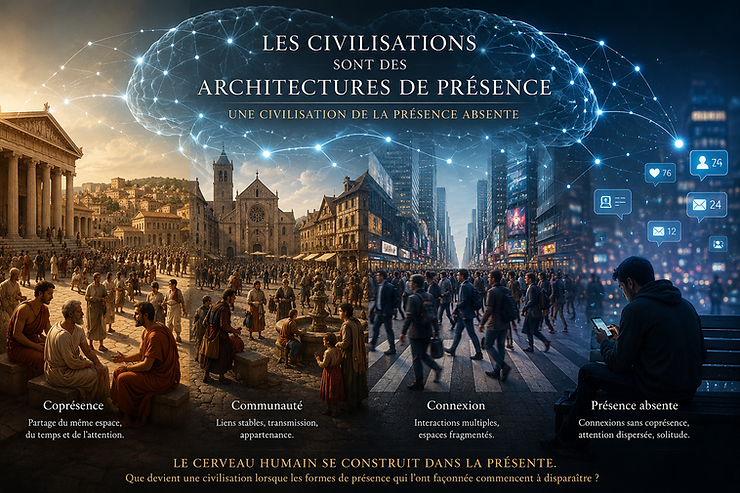
Civilizations are architectures of presence
We usually describe civilizations through their institutions, beliefs, economic systems, or technologies. These are useful categories, but they mask a more fundamental reality.
A civilization organizes forms of presence. It determines who lives with whom, who grows up with whom, who works with whom, who cares for whom, who can rely on whom. Villages, extended families, public squares, markets, schools, places of worship, workshops—all these invisible architectures define the conditions under which human beings meet, cooperate, learn, transmit knowledge, and build their lives.
If the human brain is built in presence, then civilizations do not only shape behaviors or beliefs. They participate indirectly in the very construction of the brains that compose them.
This perspective is not insignificant. It allows us to look at realities as different as an Athenian agora, a Buddhist monastery, a Koranic school or a contemporary open space through the same lens: how do they organize the question of who is present to whom, under what conditions and for what purposes?
For most of human history, these structures were based on physical co-presence. Relationships developed in shared spaces. Children grew up surrounded by familiar figures. Learning was transmitted from body to body, from gesture to gesture, from gaze to gaze. The essential activities of life—birth, learning, work, care, death—took place in the presence of others.
Presence was not a question. It constituted the very environment in which human life was organized, as naturally as air or light.
We know that a child needs a sufficiently safe physical environment to survive, and a biological environment compatible with health. Research on attachment and development suggests that there is a third, equally fundamental level: a relational environment that is sufficiently rich, stable, and predictable to allow the brain to develop.
From Rome to the metropolises
The founding of Rome offers a revealing image of this reality. When the Romans recounted their origins, they didn't begin with laws or institutions. They told a story of survival, abandonment, and protection: two infants left on the banks of the Tiber, taken in first by a she-wolf, then by a shepherd. What is striking in this story is not only its initial violence, but the chain of intervening lives that saves these two vulnerable beings and allows them to ultimately become the founders of a city.
Great civilizations then invented ever more complex forms of collective organization—cities, empires, universities, hospitals, guilds, academies. All can be viewed, from a certain perspective, as systems for organizing encounters, cooperation, and forms of interaction between individuals. Contemporary metropolises are their direct heirs—until connectivity architectures redefine the rules.
An unprecedented transformation
For the past few decades, something new has appeared in the history of our species.
It has become possible to maintain a large number of interactions without sharing the same space. We can collaborate without meeting, learn without being in the same room, work without a common area, and nurture relationships without seeing each other for months or years. This transformation is far-reaching, even though it has occurred so gradually and naturally that it has often been absorbed without being truly questioned.
The main architectures of presence that had accompanied the evolution of the human brain are thus beginning to be systematically replaced — or at least supplemented — by architectures of connection.
The difference may seem subtle. It is not.
When connection replaces presence
A message can convey information. A video conference can transmit a conversation. A social network can maintain a connection. But these signals remain, by their very nature, probable indicators rather than certainties: a "seen," an "online" status, a notification never definitively proves whether the other person is truly available—they merely feed, remotely and in a degraded way, the same estimation the brain has always made in physical presence. But do these devices truly reproduce all the dimensions of human presence?
When two people share the same space, their brains exchange far more than words. Eye contact, facial expressions, gestures, silences, bodily rhythms, and subtle attentional and emotional adjustments constantly contribute to the relationship. Physical co-presence triggers a measurable physiological synchronization—heart rate, skin conductance, neuronal activity—that has no exact equivalent in mediated interactions. Much of social regulation, and especially emotional regulation, relies precisely on these mechanisms, which digital technologies filter, compress, or suppress.
The question, therefore, is not whether technologies create connections. They do, and sometimes connections of remarkable richness and durability. The question is more precise: what forms of presence do these devices preserve , what forms do they transform , and what forms do they gradually make rarer in the daily experience of individuals? préservent-ils, quelles formes transforment-ils, et quelles formes rendent-ils progressivement plus rares dans l’expérience quotidienne des individus ?
A civilizational experiment without witnesses
In this context, one point deserves to be emphasized. John Cacioppo's work on loneliness has established that subjective loneliness—the feeling of not truly being present with others, even when speaking to them—is not merely a painful experience. It is a measurable health risk factor, the extent of which has led several public health institutions to compare it to other well-established major risk factors.
On an evolutionary scale, this transformation is extraordinarily recent. A few decades represent barely a moment in the history of a brain that has been shaped over hundreds of thousands of years in an environment of near-constant co-presence. We are conducting, without having decided to or even being fully aware of it, an experiment of unprecedented magnitude on the relational conditions of human development.
The history of human development shows that some forms of suffering do not result solely from the presence of negative experiences; they can also arise from the absence of certain essential experiences. Just as a plant suffers not only from poison but also from a lack of light, the human brain seems to be affected not only by the traumas it experiences but also by the forms of presence it has lacked.
And we are already observing certain phenomena that deserve attention. Never before have human beings been so connected—and yet, feelings of loneliness, isolation, or inner emptiness are increasingly prominent in the epidemiological surveys of many societies. Never before has it been so easy to reach someone on the other side of the world—and yet, many people feel a lack of presence. Not of information, not of contact, but of presence.
It would be simplistic to attribute this paradox solely to digital technologies. Urban transformations, geographical mobility, and the erosion of extended family structures also contribute. But it would be equally unwise to assume that such profound changes in forms of presence have no effect on brains that have developed over millennia in a radically different relational environment.
Presence as a civilizational issue
For a long time, presence was taken for granted. Today, it becomes visible precisely because it changes — and what becomes visible through change often reveals something essential about what didn't need to be named as long as it lasted.
The questions now being asked extend far beyond neuroscience. They concern education: what happens between a student and a teacher that cannot be replicated by a screen? Work: what is lost, what is gained in the gradual disappearance of the common place? Urban planning: why do cities that encourage chance encounters seem to generate more well-being than those that discourage them? Mental health: why does face-to-face therapy retain, for many patients, an effectiveness that remote therapy does not fully replicate? And, tomorrow, artificial intelligence: what does the presence of an entity that responds, adapts, seems to understand—but is not actually there —mean ? là ?
Behind each of these transformations lies the same fundamental question: what forms of presence are necessary for human development, for emotional regulation, for the ability to live with others?
What this changes — and what it entails
If the human brain is built upon presence and continues to regulate itself through it, then contemporary transformations in the forms of presence do not constitute merely a technological or social change. They constitute an anthropological shift. Perhaps even a civilizational shift in the fullest sense of the term: a transformation affecting the very conditions under which human beings become who they are.
Previous generations profoundly transformed their material environment—the soil, the water, the climate. Ours is transforming, with unprecedented speed, the relational environment in which human beings live, learn, work, and construct their identities. Just as the first transformation led to the emergence of an ecological understanding of the planet, the second perhaps calls for an ecological understanding of presence: a reflection on the relational conditions that allow the human brain to develop, regulate itself, and remain fully human.
If presence is indeed one of the fundamental resources the human brain needs to develop and maintain itself, then these results take on an even broader significance. They suggest that transformations in our relational environment are not solely a matter of communication technologies, social organization, or public policy. They could affect the very foundations of our individual and collective development.
Si la présence constitue effectivement l’une des ressources fondamentales dont le cerveau humain a besoin pour se construire et se maintenir, alors ces résultats prennent une signification plus large encore. Ils suggèrent que les transformations de notre environnement relationnel ne relèvent pas seulement des technologies de communication, de l’organisation sociale ou des politiques publiques. Elles pourraient toucher aux fondements mêmes de notre développement individuel et collectif.
The question, therefore, is not whether we should go back—that would be both impossible and pointless. It is simpler, and more demanding: what becomes of a civilization when the architectures of presence that have shaped it for millennia are gradually replaced by architectures of connection?
It is this question that the civilizational dimension of the Brain of Presence proposes to explore — not to answer it definitively, but to learn to ask it with the rigor it deserves. Cerveau de la Présence se propose d’explorer — non pour y répondre définitivement, mais pour apprendre à la poser avec la rigueur qu’elle mérite.
References
Cacioppo, J. T. & Patrick, W. (2008). Loneliness: Human Nature and the Need for Social Connection. Norton.
Holt-Lunstad, J., Smith, T.B., Baker, M., Harris, T. & Stephenson, D. (2015). Loneliness and social isolation as risk factors for mortality: A meta-analytic review. Perspectives on Psychological Science, 10(2), 227–237.
Coan, JA, Schaefer, HS & Davidson, RJ (2006). Lending a hand: Social regulation of the neural response to threat. Psychological Science, 17(12), 1032–1039.
Esmaïli, A., Demolliens, M., Viersen, M., et al. (2025). Probabilistic inference of social presence across brain scales reveals enhanced synaptic efficacy. Communications Biology, 8, 1608.
US Department of Health and Human Services (2023). Our Epidemic of Loneliness and Isolation: The US Surgeon General's Advisory on the Healing Effects of Social Connection and Community.
Articles and links to explore
The Brain of Presence:
General presentation of the project and the question that constitutes its starting point.
The social brain: an incomplete revolution
How social neuroscience has transformed our understanding of the brain, and why the question of presence could complement this theoretical framework.
Phenomenology of Presence:
Why certain ordinary experiences — shared silence, feeling watched, soothing or threatening presence — can help us understand the role of presence in human experience.
Presence before the relationship
In an elevator, a waiting room or a train, the mere presence of another person is often enough to transform our experience.
Attachment: A Science of Presence
Videos, reflections and explorations around the neuroscience of presence, attachment, development and psychotherapy.
YouTube Channel — The Brain of Presence
Videos, reflections and explorations around the neuroscience of presence, attachment, development and psychotherapy.
Dr. Driss Boussaoud — The Brain of Presence